

If you’re running a lending business — whether it’s a bank, NBFC, credit union, or private lender — you already know how chaotic things can get without the right system in place. Missed payments, scattered borrower data, compliance headaches, manual calculations… the list goes on.
That’s exactly why a robust Loan Management System (LMS) isn’t a luxury anymore — it’s a necessity.
But here’s the thing: not all loan management systems are built the same. Some are bloated with features you’ll never use. Others are too bare-bones to handle real-world lending operations. So how do you know what to look for?
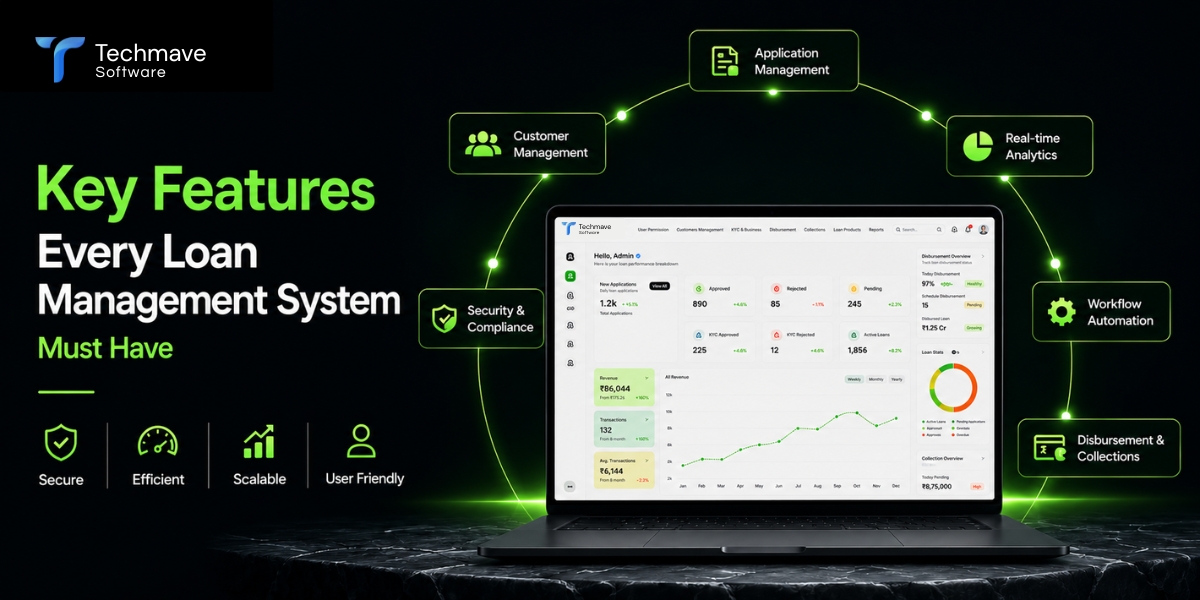
In this guide, we’re breaking down the key features every loan management system must have — the ones that actually move the needle for your lending business.
What Is a Loan Management System, and Why Does It Matter?
A Loan Management System is a software platform that automates and manages the entire lifecycle of a loan — from the moment a borrower applies to the day the loan is fully paid off.
Think of it as the command center for your lending operations. It handles loan origination, credit assessment, disbursement, EMI scheduling, repayment tracking, collections, and compliance — all under one roof.
Without a proper LMS, lenders often end up juggling spreadsheets, disconnected tools, and manual processes that are slow, error-prone, and nearly impossible to scale. With the right one, you can process more loans in less time, reduce defaults, and deliver a better borrower experience.
Now let’s get into the features that truly matter.
1. End-to-End Loan Origination Module
The loan origination process is the first impression your borrower has of your lending operation. A good LMS must offer a fully digital loan origination workflow that allows borrowers to apply online, submit documents, and get decisions — fast.
Key capabilities to look for:
- Customizable application forms for different loan types (personal, business, mortgage, auto)
- Document upload and e-KYC integration
- Automated eligibility checks
- Instant or rule-based preliminary approvals
A modern loan origination software module eliminates the back-and-forth that slows down loan processing and leaves borrowers frustrated.
2. Automated Credit Scoring and Underwriting
Manual credit assessment is time-consuming and inconsistent. Your LMS should have a built-in or integrated automated underwriting engine that evaluates creditworthiness based on predefined rules, scoring models, or third-party bureau data.
This includes:
- Integration with credit bureaus (CIBIL, Equifax, Experian, etc.)
- Custom risk scoring models
- Debt-to-income ratio calculations
- Fraud detection flags
Automated underwriting doesn’t just save time — it removes human bias and creates a consistent, auditable credit decision trail. That’s gold from both an operational and a compliance standpoint.
3. Flexible Loan Configuration and Product Management
Every lender has different products — and those products evolve. Your LMS needs to support flexible loan product configuration without requiring a developer every time you want to tweak something.
This means the system should let you configure:
- Interest rate types (flat, reducing balance, compound)
- Repayment schedules (monthly, bi-weekly, bullet)
- Loan tenure and grace periods
- Late fee structures and penalties
- Prepayment and foreclosure rules
Whether you’re offering microloans, home loans, or BNPL products, your digital lending solution should adapt to your product catalog — not the other way around.
4. EMI Calculation and Amortization Engine
This one sounds obvious, but you’d be surprised how many systems get it wrong. A reliable EMI calculation software module is foundational to your LMS.
It should automatically generate:
- Amortization schedules based on loan terms
- Dynamic recalculations when repayments are missed or prepaid
- Accurate interest accrual accounting
- Detailed payment breakdowns for borrowers
Transparency in repayment schedules builds borrower trust — and reduces disputes significantly.
5. Borrower Management and CRM Capabilities
Your LMS shouldn’t just track loans — it should track the people behind those loans. A strong borrower management system gives you a 360-degree view of each customer: their loan history, repayment behavior, communication log, and current outstanding obligations.
Look for:
- Centralized borrower profiles
- Multi-loan management per borrower
- Communication history (calls, SMS, emails)
- Document storage and retrieval
- Customer segmentation for targeted campaigns
When your team has full borrower context at their fingertips, they make better decisions — and borrowers feel like more than just a loan number.
6. Loan Disbursement and Payment Processing
Speed matters in disbursement. A borrower who gets their funds faster is a happier borrower — and a more loyal one. Your loan servicing platform should support seamless integration with payment gateways, bank APIs, and digital wallets for:
- Instant or scheduled fund disbursements
- Multiple disbursement modes (NEFT, IMPS, UPI, direct bank transfer)
- Automated repayment collection (auto-debit, NACH mandates)
- Real-time payment reconciliation
- Failed payment alerts and retry logic
Manual payment processing is one of the biggest bottlenecks in lending operations. Automating it isn’t optional if you want to scale.
7. Delinquency Management and Collections Automation
Defaults and late payments are a fact of life in lending. The question is — how fast and how intelligently does your system respond?
A modern automated loan processing system should include a dedicated delinquency and collections module that:
- Automatically flags overdue accounts based on DPD (Days Past Due)
- Triggers escalation workflows for different delinquency buckets
- Sends automated reminders via SMS, email, and push notifications
- Assigns accounts to collection agents with a priority queue
- Tracks recovery actions and outcomes
Proactive collections management reduces your Non-Performing Assets (NPAs) and keeps your loan portfolio healthy.
8. Loan Portfolio Management and Analytics
You can’t manage what you can’t measure. A good loan portfolio management module gives you real-time visibility into the health of your entire lending book.
Your LMS should offer dashboards and reports covering:
- Disbursement volumes and trends
- Portfolio at risk (PAR) ratios
- Repayment rates and delinquency trends
- Loan product performance comparison
- Branch, agent, or channel-level breakdowns
Advanced LMS platforms also offer predictive analytics — flagging borrowers likely to default before they actually do, so you can take preventive action.
9. Compliance and Regulatory Reporting
Lending is one of the most regulated industries in the world — and for good reason. Your LMS must be built with compliance in mind, not bolted on as an afterthought.
This means support for:
- RBI/SEBI or jurisdiction-specific regulatory guidelines
- Automated generation of compliance reports
- Audit trails for every action taken in the system
- Data privacy controls (GDPR, DPDP Act)
- KYC/AML checks and documentation
A compliance-ready LMS protects your business from regulatory penalties and builds the kind of institutional trust that helps you grow.
10. Role-Based Access Control and Security
Financial data is sensitive. Your LMS should enforce granular role-based access control (RBAC) so that each team member sees and does only what they’re authorized to.
Key security features to demand:
- Multi-factor authentication (MFA)
- Encrypted data storage and transmission
- Role-specific dashboards and permissions
- Activity logs and anomaly detection
- Secure API integrations
A data breach in a lending operation isn’t just costly — it can be catastrophic for your reputation and your borrowers’ financial safety.
11. Multi-Channel and Mobile Accessibility
Your borrowers expect to engage with you on their terms — on their phones, at any time. A modern fintech lending platform must support:
- Mobile-friendly borrower portals for applications and repayments
- Loan officer mobile apps for field collections and verification
- Omnichannel communication (WhatsApp, SMS, email, app notifications)
- Offline functionality for agents in low-connectivity areas
Mobility isn’t a nice-to-have anymore. It’s a competitive differentiator.
12. Third-Party Integrations and Open API Architecture
No LMS operates in isolation. You’ll need it to talk to your core banking system, accounting software, credit bureaus, payment gateways, and more. Look for an LMS that offers:
- RESTful APIs for custom integrations
- Pre-built connectors for popular tools (Tally, QuickBooks, Salesforce)
- Webhook support for real-time event triggers
- Marketplace or ecosystem of certified integrations
An open API architecture future-proofs your lending stack and avoids the trap of being locked into a rigid, closed system.
13. Cloud-Based Infrastructure and Scalability
If your LMS lives on aging on-premise servers, you’re already behind. A cloud-based loan management platform offers:
- Automatic backups and disaster recovery
- On-demand scalability as your loan book grows
- Lower upfront infrastructure costs
- Continuous feature updates without downtime
- Global accessibility for distributed teams
Whether you’re processing 100 loans a month or 100,000, your infrastructure should scale with you — not become a ceiling.
Choosing the Right Loan Management System: Key Questions to Ask
Before committing to any platform, ask vendors these critical questions:
- Can the system handle the specific loan products we offer today — and the ones we plan to launch?
- How long does implementation typically take, and what does the onboarding process look like?
- What’s the uptime SLA, and what does your disaster recovery plan look like?
- How is pricing structured — per loan, per user, or flat fee?
- Is the system compliant with our local regulatory requirements?
- What level of customization is possible without custom development?
The answers to these questions will tell you a lot about whether a vendor is truly a partner — or just a vendor.
How Techmave Software Can Help You Build or Implement the Right LMS
At Techmave Software LLC, we specialize in building custom, scalable software solutions for the financial services industry — including fully tailored Loan Management Systems that align with how your lending business actually works.
We don’t believe in one-size-fits-all. Our team of experienced software and mobile app developers works closely with banks, NBFCs, microfinance institutions, and fintech startups to deliver:
✅ Custom Loan Management Software built from the ground up for your specific loan products and workflows
✅ Mobile-First Lending Apps for both borrowers and loan officers — iOS and Android
✅ API-First Architecture for seamless integration with your existing banking and payment infrastructure
✅ Automated Underwriting and Credit Scoring Engines tailored to your risk appetite
✅ Regulatory Compliance Modules designed for your jurisdiction
✅ Real-Time Analytics Dashboards to keep your loan portfolio always in view
✅ Ongoing Support and Maintenance so your system evolves as your business does
Whether you’re looking to build a new LMS from scratch, modernize a legacy lending platform, or add smart automation to your existing workflows — Techmave Software has the expertise to make it happen.
Ready to transform your lending operations? Get in touch with the Techmave Software team today and let’s build something exceptional together.
Final Thoughts
A Loan Management System is the backbone of any modern lending operation. The right one doesn’t just automate tasks — it transforms the way you originate, service, and grow your loan portfolio. From automated credit scoring to real-time analytics and mobile accessibility, the features we’ve covered in this guide aren’t optional extras. They’re the baseline for running a competitive, compliant, and scalable lending business in today’s digital-first world.
The question is no longer whether you need a capable LMS — it’s which one is right for your unique needs. And that’s exactly where the right development partner makes all the difference.
Frequently Asked Questions (FAQs)
Q1. What is a Loan Management System and what does it do?
A Loan Management System (LMS) is a software platform that automates and manages the complete lifecycle of a loan — from application and credit assessment to disbursement, EMI collection, and final closure. It helps lenders streamline operations, reduce manual errors, improve borrower experience, and stay compliant with regulatory requirements. Banks, NBFCs, credit unions, microfinance institutions, and fintech lenders all use LMS platforms to manage their lending portfolios efficiently.
Q2. What are the most important features of a Loan Management System?
The most critical features of a Loan Management System include: a digital loan origination module, automated credit scoring and underwriting, flexible loan product configuration, EMI and amortization calculation, borrower CRM, automated disbursement and payment collection, delinquency and collections management, real-time portfolio analytics, compliance and regulatory reporting, role-based access control, mobile accessibility, and open API integrations. Together, these features cover the full lending lifecycle and ensure operational efficiency and compliance.
Q3. How does a Loan Management System differ from a Core Banking System?
A Core Banking System (CBS) manages a bank’s overall operations — including deposits, accounts, and transactions. A Loan Management System is a specialized platform focused specifically on the end-to-end management of loans. While some core banking systems include basic loan modules, a dedicated LMS offers far deeper functionality for loan origination, underwriting, servicing, and collections. Many lenders integrate an LMS with their CBS to get the best of both worlds.
Q4. What is loan origination software and why is it important?
Loan origination software is the component of a Loan Management System that handles the initial stages of the lending process — from the borrower’s application submission through credit assessment, document verification, and loan approval. It’s important because it directly impacts how fast and accurately lenders can process new applications. A good loan origination software reduces turnaround time, eliminates manual paperwork, and creates a seamless borrower onboarding experience.
Q5. Can a Loan Management System help reduce loan defaults and NPAs?
Yes, significantly. A modern Loan Management System helps reduce defaults and Non-Performing Assets (NPAs) through automated delinquency tracking, early warning systems that flag at-risk borrowers, proactive payment reminders via SMS and email, structured collections workflows, and predictive analytics that identify potential defaults before they occur. By enabling faster and more consistent collections action, an LMS can meaningfully improve repayment rates across your loan portfolio.
Q6. Is a cloud-based Loan Management System better than an on-premise one?
For most lenders — especially those looking to scale — a cloud-based Loan Management System offers significant advantages over on-premise software. These include lower upfront infrastructure costs, automatic backups, on-demand scalability, continuous updates, and remote accessibility for distributed teams. On-premise systems may still be preferred by large institutions with strict data sovereignty requirements, but cloud-based platforms have become the industry standard for modern digital lenders.
Q7. How long does it take to implement a Loan Management System?
Implementation timelines vary depending on the complexity of the LMS and the lender’s specific requirements. A ready-made or SaaS-based LMS can be deployed in as little as 4–8 weeks. A fully custom-built Loan Management System — like those developed by Techmave Software — typically takes 3–6 months, depending on the scope of features, integrations, and regulatory customizations required. A phased implementation approach, starting with core modules, can significantly reduce time-to-go-live.
Q8. How much does it cost to build or buy a Loan Management System?
The cost of a Loan Management System depends on whether you’re buying an off-the-shelf platform or building a custom solution. SaaS-based LMS platforms typically charge per user or per loan processed, with monthly fees ranging from a few hundred to several thousand dollars depending on scale. Custom-built LMS solutions involve a larger upfront development investment but offer full ownership, flexibility, and no recurring licensing fees. For an accurate cost estimate tailored to your lending business, it’s best to consult with a software development partner like Techmave Software.