

Artificial intelligence has rapidly evolved from a futuristic concept into a practical business tool. Today, AI agents are transforming how organizations operate by automating repetitive tasks, improving customer support, streamlining internal workflows, and enabling smarter decision-making.
Whether you’re planning to build an AI customer support assistant, an intelligent sales agent, or an enterprise automation solution, one of the first questions you’ll likely ask is:
“How much does AI agent development cost?”
The answer depends on several factors, including the complexity of the agent, the AI models used, integrations with existing systems, security requirements, deployment environment, and ongoing maintenance.
In most cases, the AI agent development cost ranges between $10,000 and $300,000+, depending on your business goals and technical requirements. A simple AI assistant may require only a few weeks of development, while a fully autonomous enterprise AI agent with custom integrations can take several months and a significantly larger investment.
In this comprehensive guide, we’ll explain everything you need to know about AI agent development costs, the factors that influence pricing, different types of AI agents, and practical tips to maximize your return on investment.
What Is an AI Agent?
An AI agent is an intelligent software system capable of understanding information, making decisions, and performing tasks with minimal human intervention.
Unlike traditional software that follows fixed rules, AI agents learn from data, understand natural language, analyze context, and continuously improve their performance.
Modern AI agents can:
- Answer customer questions instantly
- Automate repetitive business processes
- Schedule meetings and appointments
- Generate reports
- Analyze business data
- Assist employees with daily tasks
- Recommend products or services
- Manage workflows across multiple applications
Businesses across industries are investing in AI agent development because these intelligent systems help reduce operational costs, increase productivity, and deliver better customer experiences.
Why Are Businesses Investing in AI Agents?
Companies are adopting AI agents for one simple reason—they deliver measurable business value.
Some of the biggest benefits include:
Increased Productivity
AI agents automate repetitive tasks, allowing employees to focus on higher-value work.
Lower Operational Costs
Automation reduces manual effort, minimizes errors, and lowers staffing costs.
24/7 Customer Support
Unlike human agents, AI systems can provide continuous support around the clock.
Faster Decision-Making
AI analyzes large volumes of data in seconds, helping businesses make informed decisions more quickly.
Better Customer Experience
Personalized responses and instant support improve customer satisfaction and loyalty.
As AI technology becomes more accessible, organizations of all sizes are investing in custom AI solutions to remain competitive.
AI Agent Development Cost: Average Pricing in 2026
The cost of building an AI agent varies significantly depending on its complexity and capabilities.
| AI Agent Type | Estimated Development Cost | Development Timeline |
|---|---|---|
| Basic AI Chatbot | $10,000 – $25,000 | 3–6 Weeks |
| Customer Support AI Agent | $20,000 – $50,000 | 1–2 Months |
| AI Sales Assistant | $30,000 – $70,000 | 2–3 Months |
| Workflow Automation Agent | $40,000 – $90,000 | 2–4 Months |
| AI Research Agent | $60,000 – $120,000 | 3–5 Months |
| Enterprise AI Agent | $100,000 – $300,000+ | 4–8 Months |
These estimates may vary depending on your project scope, technology stack, AI model selection, and custom integrations.
What Factors Affect AI Agent Development Cost?
Several technical and business factors influence the final development cost.
1. Type of AI Agent
The biggest cost factor is the type of AI agent you want to build.
A simple FAQ chatbot requires far fewer resources than an autonomous AI agent capable of making decisions and interacting with multiple enterprise systems.
For example:
- AI Customer Support Agent
- AI Sales Agent
- AI HR Assistant
- AI Coding Assistant
- AI Finance Assistant
- AI Healthcare Agent
- AI Legal Assistant
- AI Research Agent
Each requires different levels of intelligence, integrations, and security.
2. AI Model Selection
Choosing the right AI model significantly impacts your budget.
Businesses generally choose between:
- Open-source LLMs
- Proprietary AI models
- Custom-trained language models
- Fine-tuned enterprise AI models
While open-source models reduce licensing costs, custom-trained models require additional development and infrastructure.
3. Custom Features
The more features your AI agent includes, the higher the development cost.
Popular AI agent features include:
- Natural Language Processing (NLP)
- Voice recognition
- Multi-language support
- Memory and context retention
- Image understanding
- Document processing
- Workflow automation
- Knowledge base integration
- Personalized recommendations
- Analytics dashboard
Each feature adds additional development hours.
4. Third-Party Integrations
Most AI agents need to connect with existing business systems.
Common integrations include:
- CRM platforms
- ERP software
- Slack
- Microsoft Teams
- Google Workspace
- Email systems
- Payment gateways
- Helpdesk software
- Databases
- Cloud storage
Complex API integrations increase both development time and testing efforts.
5. UI/UX Design
An AI agent is only as effective as its user experience.
A simple chat interface costs much less than an AI platform with:
- Admin dashboard
- Analytics
- Role-based access
- Multi-user management
- Custom workflows
- Reports
- Visual builders
Investing in intuitive UI design improves user adoption and long-term ROI.
6. Security and Compliance
Businesses handling sensitive information require enterprise-grade security.
Depending on your industry, your AI solution may need:
- End-to-end encryption
- Role-based access control
- GDPR compliance
- HIPAA compliance
- SOC 2 standards
- Audit logs
- Data masking
- Secure authentication
These security measures increase development complexity but are essential for protecting business and customer data.
7. AI Training and Fine-Tuning
Generic AI models don’t always understand your business.
Many organizations invest in:
- Custom knowledge bases
- Company documentation
- Product manuals
- Internal SOPs
- Customer support history
- Industry-specific datasets
Training an AI agent with business-specific information significantly improves response quality but also adds to the overall AI agent development cost.
8. Deployment Infrastructure
Your deployment environment also affects pricing.
Businesses can deploy AI agents:
- On-premises
- Private cloud
- Public cloud
- Hybrid cloud
Cloud infrastructure costs vary based on storage, GPU usage, traffic volume, and AI inference requirements.
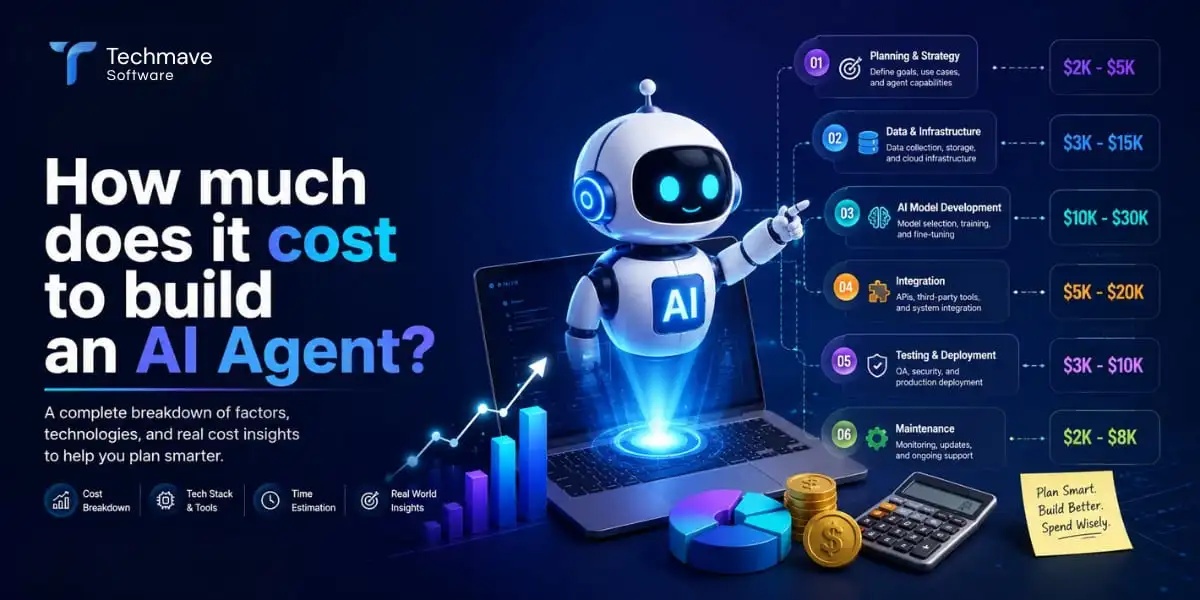
AI Agent Development Cost Breakdown by Development Stage
Understanding where your budget goes helps you plan your project more effectively.
| Development Stage | Estimated Cost |
| Discovery & Planning | $2,000–$8,000 |
| UI/UX Design | $3,000–$15,000 |
| AI Model Development | $10,000–$60,000 |
| Backend Development | $8,000–$40,000 |
| Frontend Development | $5,000–$20,000 |
| API Integrations | $5,000–$30,000 |
| Testing & QA | $5,000–$15,000 |
| Deployment | $2,000–$10,000 |
| Maintenance & Support | 15–25% annually |
Every project has unique requirements, so these figures should be considered as general estimates rather than fixed pricing.
AI Agent Development Cost by Agent Type
Customer Support AI Agent
These AI agents handle customer inquiries, resolve common issues, provide instant responses, and reduce support workloads.
Estimated Cost: $20,000–$60,000
Ideal for:
- SaaS companies
- E-commerce businesses
- Healthcare providers
- Financial services
AI Sales Assistant
Sales AI agents qualify leads, schedule meetings, send follow-up messages, and assist sales teams throughout the customer journey.
Estimated Cost: $30,000–$80,000
Common Features:
- CRM integration
- Lead scoring
- Meeting scheduling
- Email automation
- Sales analytics
Workflow Automation AI Agent
These agents automate repetitive business operations by connecting multiple applications and executing predefined workflows.
Estimated Cost: $40,000–$90,000
Common use cases include:
- HR onboarding
- Invoice processing
- Document approvals
- IT support
- Internal operations
Enterprise AI Agent
Enterprise AI agents are highly sophisticated systems capable of supporting multiple departments, handling complex workflows, accessing large knowledge bases, and integrating with enterprise software.
Estimated Cost: $100,000–$300,000+
These solutions are designed for large organizations seeking scalable AI-powered automation across finance, operations, HR, sales, and customer service.
AI Agent Development Cost by Industry
The cost of building an AI agent also depends on the industry you’re serving. Industries with strict compliance requirements, sensitive customer data, or complex workflows typically require more advanced AI solutions, increasing development costs.
| Industry | Estimated Cost |
|---|---|
| Healthcare | $60,000 – $250,000+ |
| Finance & Banking | $70,000 – $300,000+ |
| E-commerce | $20,000 – $100,000 |
| Real Estate | $25,000 – $80,000 |
| Education | $20,000 – $75,000 |
| Manufacturing | $40,000 – $150,000 |
| Logistics & Supply Chain | $50,000 – $180,000 |
| Legal Services | $60,000 – $200,000 |
For example, a healthcare AI agent may require HIPAA compliance, while a financial AI assistant must meet strict security standards and integrate with multiple banking systems. These additional requirements naturally increase development costs.
Hidden Costs of AI Agent Development
Many businesses only consider the initial development cost. In reality, building an AI agent involves ongoing investments that ensure long-term performance and reliability.
AI Model Usage
If your AI agent relies on commercial large language models, you’ll incur usage costs based on API requests, token consumption, or user activity.
Cloud Infrastructure
Hosting AI applications requires scalable cloud resources such as GPUs, databases, storage, monitoring tools, and networking services.
Maintenance and Updates
AI agents need regular updates to improve accuracy, fix bugs, enhance security, and support new features as your business grows.
Data Management
Cleaning, organizing, labeling, and updating business data is essential for maintaining high-quality AI responses.
Security and Compliance
As regulations evolve, businesses must continually update their AI systems to remain compliant with industry standards and protect customer data.
Planning for these ongoing costs helps avoid unexpected expenses after deployment.
In-House Development vs Outsourcing: Which Is More Cost- Effective?
One of the biggest decisions businesses face is whether to build an internal AI team or partner with an experienced AI development company.
| Factor | In-House Team | AI Development Company |
| Initial Investment | High | Moderate |
| Hiring Time | Long | None |
| AI Expertise | Limited | Experienced Specialists |
| Development Speed | Slower | Faster |
| Technology Access | Additional Investment | Included |
| Scalability | Limited | Highly Scalable |
| Overall Cost | Higher | More Cost Effective |
Hiring AI engineers, machine learning specialists, UI/UX designers, DevOps engineers, and QA professionals can significantly increase project costs.
Working with an experienced AI development company gives businesses access to a multidisciplinary team, proven development processes, and faster project delivery without the overhead of building an internal department.
How to Reduce AI Agent Development Cost
Building an AI agent doesn’t always require a six-figure investment. With the right strategy, businesses can control costs while still creating a powerful solution.
Start with an MVP
Develop a Minimum Viable Product (MVP) that focuses on solving one core business problem. Once it’s validated, you can expand functionality based on real user feedback.
Use Existing AI Models
Instead of training models from scratch, leverage proven large language models and fine-tune them for your specific use case.
Prioritize High-Impact Features
Avoid feature overload during the first release. Focus on capabilities that deliver measurable business value.
Choose Scalable Architecture
A modular architecture allows you to add features later without rebuilding the entire system.
Partner with an Experienced AI Development Company
Experienced development teams can reduce costly mistakes, accelerate delivery, and recommend the most efficient technology stack for your budget.
AI Technologies Commonly Used for AI Agent Development
Choosing the right technology stack directly impacts development speed, scalability, and long-term maintenance.
A typical AI agent may include:
Programming Languages
- Python
- JavaScript
- TypeScript
AI Frameworks
- LangChain
- LlamaIndex
- AutoGen
- CrewAI
- Haystack
Large Language Models
- OpenAI GPT models
- Anthropic Claude
- Google Gemini
- Meta Llama
- Mistral AI
Vector Databases
- Pinecone
- Weaviate
- Chroma
- Milvus
Backend Frameworks
- FastAPI
- Node.js
- Django
Cloud Platforms
- AWS
- Microsoft Azure
- Google Cloud Platform
The ideal technology stack depends on your business goals, budget, performance requirements, and security needs.
The AI Agent Development Process
A structured development approach helps ensure your AI agent delivers real business value.
1. Discovery & Consultation
The process begins with understanding your business objectives, user needs, workflows, and technical requirements.
2. Solution Design
The development team defines the AI architecture, integrations, user journeys, and security requirements.
3. Data Preparation
Relevant business documents, knowledge bases, APIs, and datasets are collected, cleaned, and organized for AI training.
4. AI Model Development
The appropriate AI model is selected, configured, and fine-tuned based on your business use case.
5. Application Development
Developers build the user interface, backend systems, APIs, dashboards, and integrations required for the AI agent.
6. Testing & Optimization
The AI agent undergoes extensive testing to ensure accuracy, performance, scalability, and security.
7. Deployment
Once approved, the solution is deployed to your preferred cloud or on-premises environment.
8. Continuous Improvement
After launch, the AI agent is monitored and continuously optimized using user feedback and performance data.
Is Building an AI Agent Worth the Investment?
For many businesses, the answer is yes.
AI agents can automate repetitive tasks, improve operational efficiency, reduce response times, and support business growth without proportionally increasing staffing costs.
Organizations using AI-powered automation often experience benefits such as:
- Reduced operational expenses
- Faster customer response times
- Improved employee productivity
- Better decision-making through data insights
- Increased customer satisfaction
- Scalable business operations
- Higher return on investment over time
The key is to build an AI solution that aligns with your business goals rather than adopting AI simply because it’s trending.
Why Choose Techmave Software for AI Agent Development?
Building an AI agent is about more than integrating a language model—it’s about creating a reliable, secure, and scalable solution that solves real business challenges.
At Techmave Software, we specialize in delivering custom AI software tailored to your unique business requirements. From strategy and consulting to design, development, deployment, and ongoing support, our team helps businesses turn AI ideas into practical, high-performing solutions.
Our AI Development Services Include:
- Custom AI Agent Development
- AI Chatbot Development
- Generative AI Solutions
- Enterprise AI Applications
- AI Workflow Automation
- Machine Learning Solutions
- AI Integration Services
- AI Software Consulting
- Large Language Model (LLM) Integration
- AI Maintenance & Support
Why Businesses Choose Techmave Software
- Experienced AI engineers and software architects
- Customized solutions aligned with your business goals
- Scalable and secure AI applications
- Transparent development process
- Agile project delivery
- Ongoing optimization and technical support
Whether you’re looking to automate customer support, streamline operations, or build a sophisticated enterprise AI agent, Techmave Software can help you transform your vision into a production-ready solution.
Ready to build your AI agent? Contact Techmave Software today for a free consultation and receive a tailored roadmap and cost estimate for your project.
Final Thoughts
The AI agent development cost can range from $10,000 for a basic AI assistant to over $300,000 for an enterprise-grade autonomous AI solution. The final investment depends on your business objectives, required features, integrations, compliance needs, and scalability requirements.
Instead of focusing solely on the initial price, consider the long-term value an AI agent can deliver through automation, improved efficiency, enhanced customer experiences, and sustainable business growth.
Partnering with an experienced AI development company like Techmave Software ensures your investment delivers measurable results while minimizing technical risks and accelerating time to market.
Frequently Asked Questions (FAQs)
1. How much does it cost to build an AI agent?
The cost of building an AI agent typically ranges from $10,000 to $300,000+, depending on its complexity, features, AI model, integrations, and deployment requirements.
2. What factors affect AI agent development cost?
Key factors include the type of AI agent, custom features, AI model selection, third-party integrations, UI/UX design, security, compliance, cloud infrastructure, and ongoing maintenance.
3. How long does it take to develop an AI agent?
A simple AI chatbot can be developed in 3–6 weeks, while enterprise AI agents with advanced capabilities may take 4–8 months or longer.
4. Is it cheaper to use existing AI models instead of building one from scratch?
Yes. Leveraging existing large language models and fine-tuning them for your business is generally more cost-effective and significantly reduces development time.
5. Can AI agents integrate with my existing business software?
Absolutely. AI agents can integrate with CRMs, ERPs, helpdesk platforms, payment gateways, communication tools, cloud storage, and other business applications through APIs.
6. Which industries benefit the most from AI agents?
Healthcare, finance, e-commerce, logistics, education, manufacturing, legal services, and customer support teams are among the industries seeing strong returns from AI-powered automation.
7. How can I reduce AI agent development costs?
Starting with an MVP, prioritizing essential features, using pre-trained AI models, and working with an experienced AI development partner are some of the most effective ways to optimize costs.
8. Why should I choose Techmave Software for AI agent development?
Techmave Software combines AI expertise, custom software development, scalable architecture, and ongoing support to deliver AI solutions that are secure, reliable, and aligned with your business objectives. Whether you’re building your first AI assistant or a complex enterprise AI agent, our team can help you launch with confidence.