

Modern applications don’t work in isolation. Whether you’re ordering food, booking a ride, making an online payment, or signing into an app with Google, APIs are working silently in the background to make everything possible.
Today, businesses depend on API Development to connect applications, automate workflows, improve customer experiences, and build scalable digital products. A well-designed API allows different software systems to communicate efficiently, securely, and reliably.
However, building a successful API requires much more than writing code. It involves careful planning, thoughtful design, thorough testing, strong security, proper documentation, and seamless deployment.
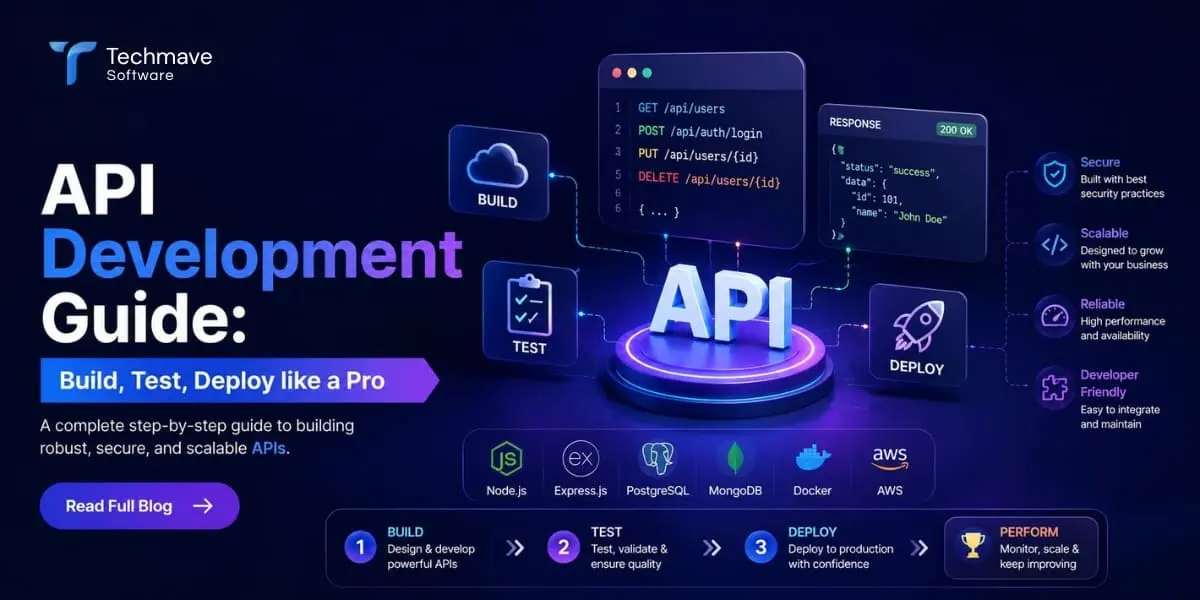
In this comprehensive guide, you’ll learn everything you need to know about API development—from planning your first endpoint to deploying production-ready APIs like an experienced developer.
What is API Development?
API Development is the process of creating Application Programming Interfaces (APIs) that allow different software applications to communicate with each other.
Think of an API as a waiter in a restaurant.
- You place an order.
- The waiter delivers it to the kitchen.
- The kitchen prepares the food.
- The waiter brings it back to your table.
Similarly, an API receives requests from one application, communicates with another system, and returns the requested information.
For example:
- Mobile apps retrieving user data
- Payment gateways processing transactions
- CRM software connecting with marketing platforms
- Ecommerce stores syncing inventory
- Healthcare systems exchanging patient records
Without APIs, modern software ecosystems wouldn’t exist.
Why API Development Matters
Businesses today rarely build every feature from scratch.
Instead, they integrate multiple services together through APIs.
Professional API Development helps organizations:
- Connect applications seamlessly
- Improve automation
- Reduce manual work
- Enable faster software development
- Support third-party integrations
- Create scalable digital ecosystems
- Enhance customer experiences
- Build mobile and web applications efficiently
Companies that invest in quality API development are better prepared for future growth and digital transformation.
Types of APIs
Choosing the right API depends on your business objectives.
1. REST APIs
REST remains the most popular API architecture.
Advantages:
- Easy to understand
- Lightweight
- Fast performance
- Works over HTTP
- Excellent for web and mobile apps
Most businesses prefer REST API development because of its simplicity and scalability.
2. GraphQL APIs
GraphQL allows clients to request exactly the data they need.
Benefits include:
- Reduced over-fetching
- Faster applications
- Better frontend flexibility
- Improved performance
It’s commonly used by companies building dynamic applications.
3. SOAP APIs
SOAP APIs are highly structured and secure.
They’re commonly used in:
- Banking
- Insurance
- Enterprise software
- Government systems
4. Internal APIs
Internal APIs help different departments within an organization communicate efficiently without exposing data publicly.
5. Public APIs
Public APIs allow third-party developers to build applications using your platform.
Examples include payment gateways, maps, weather services, and social media integrations.
Step 1: Plan Before You Build
Every successful API begins with proper planning.
Ask these questions first:
- Who will use the API?
- What problem does it solve?
- Which systems need integration?
- What data should be exposed?
- What permissions are required?
Skipping the planning stage often results in poor scalability and difficult maintenance later.
Step 2: Design Your API
Good API design improves usability and developer adoption.
Follow these API design best practices:
Use meaningful endpoint names
Instead of:
/getDataUse:
/users
/orders
/products
Follow REST conventions
Use standard HTTP methods:
GET
POST
PUT
PATCH
DELETE
This keeps your API predictable and developer-friendly.
Version Your APIs
Always include versioning.
Example:
/api/v1/usersFuture updates won’t break existing applications.
Use Standard Response Codes
Examples:
200 OK
201 Created
400 Bad Request
401 Unauthorized
404 Not Found
500 Internal Server Error
Developers immediately understand what each response means.
Step 3: Build the API
Now comes the development phase.
Popular technologies include:
Backend Frameworks
- Node.js
- Express.js
- Laravel
- Django
- Spring Boot
- ASP.NET
Databases
- MySQL
- PostgreSQL
- MongoDB
- Firebase
Authentication
- JWT
- OAuth 2.0
- API Keys
Cloud Platforms
- AWS
- Azure
- Google Cloud
Choose technologies based on project requirements rather than trends.
Step 4: Secure Your API
Security should never be an afterthought.
A vulnerable API can expose sensitive customer data and business information.
Essential API security practices include:
Authentication
Verify every user before granting access.
Popular options include:
- JWT
- OAuth
- API Keys
Authorization
Not every user should access every resource.
Role-based permissions help protect sensitive data.
Rate Limiting
Prevent abuse by limiting requests.
Example:
100 requests per minute.
HTTPS Encryption
Always use SSL encryption.
Never transmit sensitive information over unsecured connections.
Input Validation
Validate every request before processing it.
This prevents attacks such as:
- SQL Injection
- XSS
- Command Injection
Step 5: Document Your API
Good documentation dramatically improves developer experience.
Include:
- Authentication steps
- Endpoint explanations
- Parameters
- Example requests
- Sample responses
- Error messages
- Status codes
Tools like OpenAPI (Swagger) make API documentation easier to create and maintain.
Step 6: Test Your API Thoroughly
Testing is one of the most important stages of API Development.
Even small bugs can impact thousands of users.
Different types of API testing include:
Functional Testing
Ensures every endpoint works correctly.
Performance Testing
Checks how the API performs under heavy traffic.
Load Testing
Measures response time during peak usage.
Security Testing
Identifies vulnerabilities before hackers do.
Integration Testing
Confirms the API works correctly with connected systems.
Automated Testing
Automated testing speeds up releases while maintaining quality.
Popular tools include:
- Postman
- Newman
- JMeter
- Insomnia
- Cypress
Step 7: Deploy Your API
Once testing is complete, deploy your API to production.
Deployment options include:
Cloud Servers
Docker Containers
Kubernetes Clusters
Serverless Functions
Modern CI/CD pipelines help automate deployments with minimal downtime.
Monitor API Performance After Deployment
Deployment isn’t the end of the journey.
Continuous monitoring helps maintain reliability.
Track metrics such as:
- Response time
- Error rates
- Uptime
- Server health
- Request volume
- Failed authentications
- Database performance
Monitoring tools include:
- Prometheus
- Grafana
- Datadog
- New Relic
Early detection prevents larger production issues.
Common API Development Mistakes
Many development teams repeat the same mistakes.
Avoid these common pitfalls:
Poor Documentation
Developers shouldn’t have to guess how your API works.
Ignoring Security
Never expose sensitive endpoints without authentication.
No Versioning
Breaking changes frustrate users and partners.
Inconsistent Naming
Keep endpoints predictable and standardized.
Weak Error Messages
Clear error responses help developers debug faster.
No Rate Limiting
Open APIs without restrictions invite abuse.
API Development Best Practices
Professional developers follow these proven practices:
- Keep APIs simple
- Design for scalability
- Use consistent naming
- Implement caching
- Secure every endpoint
- Write automated tests
- Monitor continuously
- Optimize database queries
- Maintain accurate documentation
- Review performance regularly
Following these practices results in APIs that are reliable, secure, and easier to maintain.
Future Trends in API Development
API technology continues to evolve.
Here are some emerging trends shaping the future:
AI-Powered APIs
Artificial intelligence is making APIs smarter by enabling automation, predictive analytics, and intelligent decision-making.
Event-Driven APIs
Real-time communication through events is becoming increasingly popular for chat applications, IoT devices, and live notifications.
Serverless APIs
Developers can build scalable APIs without managing servers, reducing operational overhead and improving scalability.
GraphQL Adoption
Many organizations are moving toward GraphQL for more efficient data fetching and flexible client-side development.
API First Development
Businesses are increasingly designing APIs before building applications, making integrations faster and improving collaboration between frontend and backend teams.
Why Businesses Should Invest in Professional API Development
Building APIs isn’t just about connecting systems. It’s about creating digital infrastructure that supports long-term business growth.
Professional API Development offers several advantages:
- Faster product launches
- Easier third-party integrations
- Better customer experiences
- Improved operational efficiency
- Reduced development costs over time
- Enhanced security and compliance
- Greater scalability for future growth
Whether you’re launching a mobile app, SaaS platform, ecommerce solution, or enterprise software, robust APIs form the backbone of your technology ecosystem.
Why Choose Techmave Software for API Development?
At Techmave Software, we build secure, scalable, and high-performance APIs that power modern digital experiences. Whether you’re developing a mobile app, web platform, enterprise system, or SaaS product, our experienced developers create APIs that are reliable, well-documented, and future-ready.
Our API Development Services include:
- Custom API Development
- REST API Development
- GraphQL API Development
- Third-Party API Integration
- Payment Gateway Integration
- CRM & ERP Integration
- Cloud API Development
- API Modernization
- API Testing & Performance Optimization
- API Security Implementation
- API Documentation
- API Maintenance & Support
From strategy and architecture to deployment and ongoing optimization, Techmave Software delivers end-to-end API solutions tailored to your business goals. Our focus on clean code, robust security, and scalable architecture ensures your applications perform seamlessly as your business grows.
Looking to build a powerful API for your next project? Connect with Techmave Software and let our experts turn your ideas into scalable digital solutions.
Frequently Asked Questions (FAQs)
1. What is API Development?
API Development is the process of creating interfaces that allow different software applications to communicate, exchange data, and perform actions securely and efficiently.
2. What are the different types of APIs?
The most common types include REST APIs, GraphQL APIs, SOAP APIs, Internal APIs, Public APIs, and Partner APIs. The right choice depends on your application’s requirements and integration needs.
3. Why is API security important?
API security protects sensitive business and customer data from unauthorized access, cyberattacks, and data breaches. Strong authentication, authorization, encryption, and rate limiting are essential security measures.
4. What tools are commonly used for API testing?
Popular API testing tools include Postman, Insomnia, JMeter, Newman, Cypress, and Swagger. These tools help validate functionality, performance, reliability, and security before deployment.
5. What is the difference between REST API and GraphQL?
REST uses multiple endpoints for different resources, while GraphQL provides a single endpoint that allows clients to request exactly the data they need, improving flexibility and reducing unnecessary data transfer.
6. How long does API Development take?
The timeline depends on the project’s complexity, number of endpoints, security requirements, integrations, and testing. Simple APIs may take a few weeks, while enterprise-grade APIs can require several months.
7. What industries benefit most from API Development?
Almost every industry can benefit, including healthcare, fintech, ecommerce, logistics, education, travel, real estate, manufacturing, and enterprise software. APIs streamline operations, improve connectivity, and support digital transformation.
8. Why should I hire a professional API Development company?
A professional API Development company brings expertise in architecture, security, scalability, documentation, testing, and deployment. This helps reduce technical debt, improve performance, accelerate development, and ensure your APIs are reliable, maintainable, and ready to support future business growth.